Camera module bring-up is where embedded vision programs lose weeks they did not budget for. Driver conflicts, missing device tree overlays, untested ISP tuning files, and sensor register sequences that work on one kernel version and fail on the next are not edge cases. They are the default experience with bare sensor modules. Vadzo Imaging examines how platform-validated camera modules with production-ready Linux drivers shift the integration timeline from weeks of bring-up guesswork to hours of deployment, across the AR0821, AR1335, and AR2020 embedded camera portfolio.
FORT WORTH, TX / ACCESS Newswire / June 9, 2026 / Vadzo Imaging, a globally trusted provider of high-performance embedded vision systems, today publishes a technical breakdown of platform-validated camera module integration and the driver infrastructure that determines whether an embedded vision program ships on schedule or stalls in bring-up. For system integrators, OEMs, and embedded vision engineers, the difference between a production-ready camera module and a bare sensor module is not the sensor. It is the validated driver stack, the tested device tree overlay, the ISP tuning parameters, and the platform-specific bring-up documentation that the integrator does not have to produce from scratch.
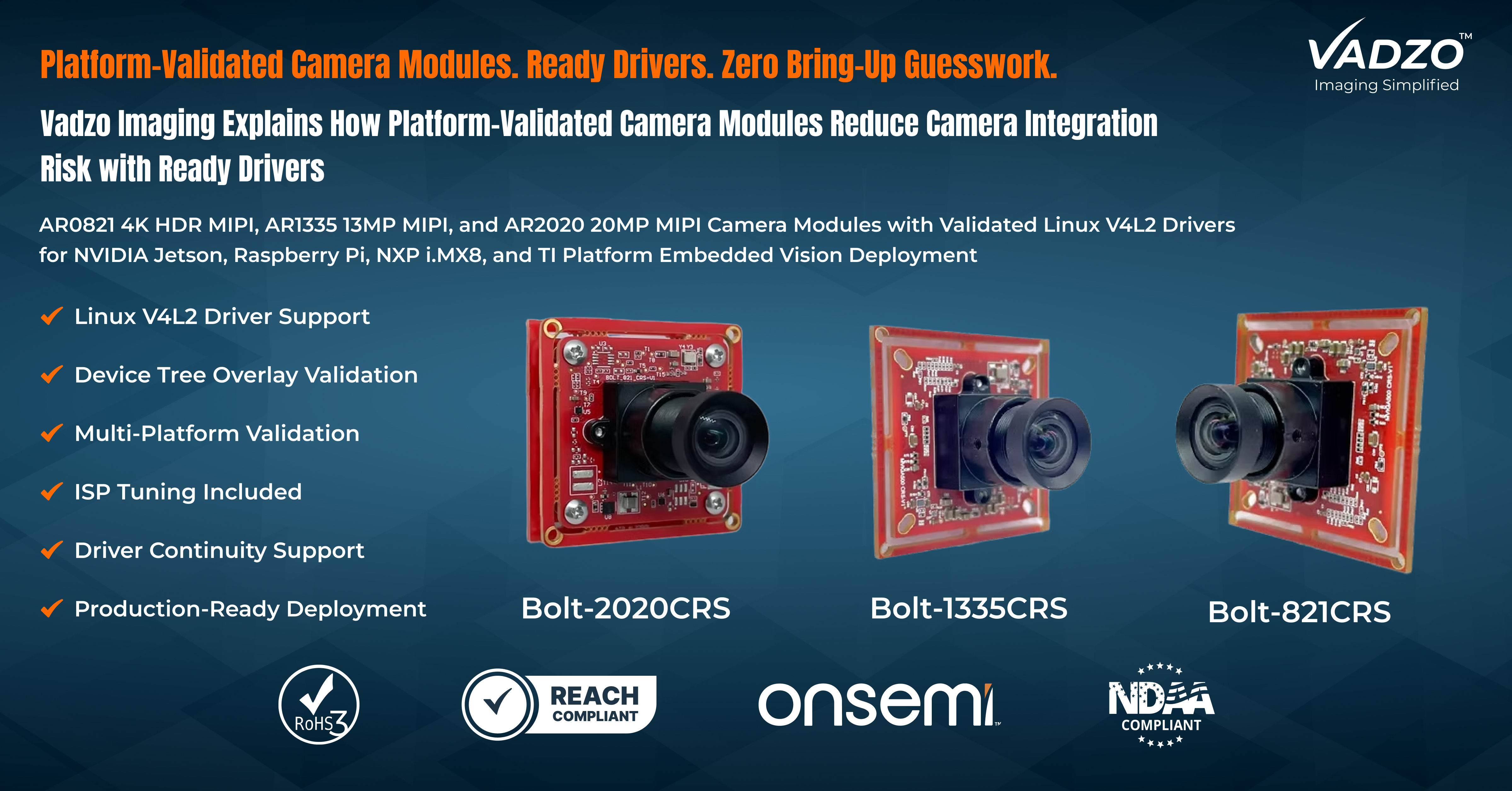
What Camera Module Bring-Up Actually Costs: The Integration Risk That Bare Sensor Modules Transfer to the Integrator
A bare sensor module ships with a datasheet and a register map. Everything between that register map and a working V4L2 video stream on a production embedded platform is the integrator’s problem. That problem has a known cost structure. Device tree overlay development for a new sensor on an existing platform takes two to four days for an experienced embedded Linux engineer and longer for teams without that specialization. ISP tuning for a new sensor on a new platform is not a one-day task. Color calibration, auto exposure curves, noise reduction parameters, and lens shading correction each require capture sessions, analysis, and iteration. A ready driver camera module changes this equation. The V4L2 camera driver is pre-written, tested, and loaded before the module ships.
Driver bring-up on a single platform version is one milestone. Validating across multiple kernel versions and multiple board revisions is another.
None of this work produces product features. It produces a working camera stream, which is the prerequisite for everything else. Embedded vision integration risk is the probability that this bring-up phase runs longer than planned, which it reliably does when the sensor is new to the platform and the driver stack is built from scratch. A validated camera driver and a tested device tree overlay do not eliminate this work. They transfer it from the integrator’s schedule to Vadzo’s validation infrastructure.
Linux V4L2 Driver Architecture and Device Tree Overlay Validation: What Platform-Validated Means in Practice
Platform-validated means the camera module has been connected to the target embedded platform, the Linux V4L2 driver has been loaded, the device tree overlay has been applied, and a working video stream has been confirmed at the specified resolution and frame rate. It means the ISP tuning parameters have been applied and verified against a reference image quality standard. It means the driver has been tested against the kernel version shipping on that platform at the time of validation, and the device tree overlay syntax matches that kernel version.
The AR0821 Color 4K HDR MIPI Camera from Vadzo Imaging carries this validation for NVIDIA Jetson, NXP i.MX8, Raspberry Pi, Rockchip, and Allwinner platforms. The driver package includes the V4L2 kernel driver, device tree overlays for each validated platform, ISP tuning files, and bring-up documentation with register initialization sequences. An integrator connecting this module to a validated platform starts with a working video stream, not a register map.
This matters operationally because the integration risk does not disappear when a camera module ships. It transfers. With a bare sensor module, it transfers to the integrator’s engineering team. With a production-ready camera module, it stays with the camera vendor’s validation infrastructure. The integrator’s bring-up time reflects whichever side of that transfer they are on.
AR1335 1.1 um BSI Pixel and 13MP MIPI Integration: Embedded Vision Bring-Up Across 4K 30fps to 720p 120fps Output Modes
The AR1335 is a 1/3.2-inch CMOS sensor with a 4208 x 3120 active pixel array at 1.1 um pixel pitch, BSI architecture, and MIPI 2, 3, or 4-lane output. It supports 4K at 30fps, 1080p at 60fps, and 720p at 120fps output modes with bit-depth compression for MIPI at 10-bit to 8-bit and 10-bit to 6-bit to reduce bandwidth requirements on constrained embedded interfaces. The AR1335 Color 13MP MIPI CSI-2 Camera from Vadzo Imaging integrates this sensor with a validated embedded Linux driver stack, device tree overlays for supported platforms, and ISP tuning for the BSI pixel response characteristics of the 1.1 um pixel at the optical formats the sensor supports.
The bring-up complexity for a 13MP sensor with multiple output modes is higher than for a single-mode module. Each output mode requires its own validated register sequence. The frame rate and resolution switching logic in the V4L2 driver must be validated against the platform’s MIPI receiver capabilities. The 3D synchronization controls on the AR1335 that enable stereo video capture require additional driver infrastructure beyond standard single-sensor bring-up. Vadzo’s validated driver package covers these cases so the integrator does not discover them mid-project.
For embedded vision deployments requiring high spatial resolution at embedded-class power budgets, the 13MP rolling shutter MIPI CSI-2 camera on the AR1335 delivers 13MP color output with the BSI sensitivity advantage of 1.1 um pixels and the multi-mode flexibility of MIPI lane configurability. The validated driver stack means the integrator gets that capability without the bring-up timeline that discovering these edge cases on a bare sensor module would cost.
AR2020 20MP MIPI Rolling Shutter Integration: High-Resolution Embedded Vision Without Custom Driver Development
A 20MP rolling shutter MIPI CSI-2 camera is not a typical embedded vision integration. The data volumes at 20MP full resolution demand careful MIPI lane configuration, DMA buffer management, and ISP pipeline sizing. Most embedded platforms have not been validated against 20MP sensors by their board manufacturers. The integrator starting from a bare sensor module at 20MP is building driver infrastructure that the platform SDK was not designed to include.
The 20MP AR2020 color MIPI CSI-2 camera from Vadzo Imaging addresses this directly. The AR2020 is a 5120 x 3840 color rolling shutter sensor with MIPI CSI-2 output. Vadzo’s validated driver package includes the V4L2 driver with DMA buffer configuration for supported platforms, device tree overlays with MIPI lane and clock configuration validated against the platform’s receiver capabilities, and ISP tuning parameters for the AR2020’s color response.
The embedded vision system integration challenge at 20MP is not the sensor. It is the data path from the sensor to the ISP and from the ISP to application memory. A validated driver stack that has already solved the DMA configuration and MIPI timing on a specific platform removes the largest single source of integration risk on high-resolution embedded camera deployments.
V4L2 Driver Continuity Across Kernel Versions: Why Driver Maintenance Is a Deployment Risk, Not a One-Time Cost
An embedded Linux camera driver validated against kernel 5.10 does not automatically work on kernel 5.15 or 6.1. The V4L2 subsystem API changes between kernel versions. The media controller framework evolves. The MIPI CSI-2 receiver driver interfaces change on specific SoC families between releases. A production-ready camera module validated on a specific kernel version with a specific platform SDK version is a snapshot. Production deployments run for two to four years. The kernel version at deployment and the kernel version at end-of-life may differ by several major versions.
Vadzo’s driver continuity support means the camera SDK integration validated at the start of a program remains usable as the platform SDK evolves. Device tree overlay syntax is updated for new kernel versions. Driver API changes are tracked and applied before they break production builds. This is not a guarantee against all kernel changes. It is an active maintenance posture that keeps the camera module’s embedded Linux camera integration current without the integrator tracking kernel changes themselves.
Camera Module Overview
AR0821 4K HDR MIPI Camera: 8MP BSI CMOS with Validated Embedded Linux Integration
The 8MP 4K Color Rolling shutter Camera on the Onsemi AR0821 BSI CMOS delivers 4K HDR output with high quantum efficiency and validated V4L2 driver support for NVIDIA Jetson, NXP i.MX8, Raspberry Pi, Rockchip, and Allwinner platforms. Driver package includes kernel driver, device tree overlays, and ISP tuning files. S-Mount M12 optics, MIPI CSI-2 interface, RoHS 3 compliant.
Key specs: 8MP (3840 x 2160) | Onsemi AR0821 BSI CMOS | Rolling Shutter | MIPI CSI-2 | 4K HDR | Validated Linux V4L2 Driver | Device Tree Overlays | ISP Tuning Files
AR1335 13MP MIPI CSI-2 Camera: 1.1 um BSI Pixel with Multi-Mode Output Validation
The Onsemi AR0821 8MP Color MIPI Camera sits alongside the 13MP AR2020 color MIPI CSI-2 camera in Vadzo’s validated embedded camera portfolio. The AR1335 module on the 1/3.2-inch BSI CMOS at 1.1 um pixel pitch delivers 4208 x 3120 at 30fps, 1080p at 60fps, and 720p at 120fps with MIPI 2, 3, or 4-lane configuration and validated device tree overlays for each output mode on supported platforms.
Key specs: 13MP (4208 x 3120) | Onsemi AR1335 BSI CMOS | Rolling Shutter | 1.1 um Pixel | MIPI 2/3/4-Lane | 4K 30fps / 1080p 60fps / 720p 120fps | 6.8 kbits OTPM | Dual PLL | Validated Linux V4L2 Driver
AR2020 20MP MIPI CSI-2 Camera: High-Resolution Embedded Vision with Platform-Specific Driver Validation
The AR1335 Color 13MP MIPI CSI-2 Camera and the 20MP AR2020 color MIPI CSI-2 camera together represent Vadzo’s validated MIPI camera portfolio from 13MP to 20MP. The AR2020 module delivers 5120 x 3840 color rolling shutter output over MIPI CSI-2 with DMA-validated driver configuration and ISP tuning for the AR2020 color response on supported platforms.
Key specs: 20MP (5120 x 3840) | Onsemi AR2020 BSI CMOS | Rolling Shutter | MIPI CSI-2 | Validated DMA Driver Configuration | Device Tree Overlays | ISP Tuning Files
Applications Across Embedded Vision Deployments
NVIDIA Jetson Camera Integration: Validated Driver Stack for Jetson Orin, Xavier, and Nano
NVIDIA Jetson platforms use the Tegra CSI driver stack with Argus and V4L2 interfaces. Sensor bring-up on Jetson requires a V4L2 subdevice driver, a media controller configuration, and a device tree overlay with the correct MIPI clock and lane configuration for the Jetson CSI receiver. Each Jetson variant has different CSI port mappings and different MIPI receiver limitations. Vadzo’s validated NVIDIA Jetson camera integration covers the AR0821, AR1335, and AR2020 modules across Jetson Orin, Xavier NX, and Nano with platform-specific device tree overlays and documented bringup sequences.
Raspberry Pi Camera Module Integration: V4L2 Driver and Device Tree for RPi 4 and RPi 5
Raspberry Pi camera integration uses the Unicam CSI-2 receiver on RPi 4 and the CFE receiver on RPi 5, each with different driver interfaces and device tree requirements. A driver validated for RPi 4 does not automatically work on RPi 5. Vadzo’s validated Raspberry Pi camera module support covers both platforms with separate device tree overlays and kernel driver variants for each, so the integrator does not discover the RPi 4 to RPi 5 API change mid-program.
TI Platform Camera Integration: Validated Driver for TDA4x and AM6x SoC Families
TI platform camera integration on TDA4x and AM6x SoC families uses the CSIRX driver in TI’s Linux SDK. Sensor bring-up requires a DT overlay with the correct virtual channel configuration, a V4L2 subdevice driver compatible with the TI media controller framework, and ISP configuration for the VPAC ISP pipeline. Vadzo’s validated TI platform camera integration covers the AR0821 and AR1335 modules with TI Linux SDK-compatible driver packages and virtual channel configuration for multi-camera deployments.
Carrier Board Camera Integration: Custom Hardware Bring-Up Documentation
Most production embedded vision systems use a custom carrier board, not a reference development kit. The CSI-2 routing, power rail sequencing, and GPIO configuration on a custom carrier board differs from the reference design. Vadzo’s carrier board camera integration support includes bring-up documentation with power-on sequencing requirements, MIPI signal integrity guidance, and register initialization order for each supported sensor. This reduces the custom hardware bring-up time from days of oscilloscope debugging to hours of documented configuration.
Industrial Inspection and AGV Navigation: Production Deployment Camera Module for High-Throughput Pipelines
Production deployment camera modules for industrial inspection and AGV navigation require driver stability across thermal cycles, consistent frame timing under varying bus load, and predictable behavior during system suspend and resume. Vadzo’s production-ready camera modules have been validated for these operating conditions on supported platforms. The embedded vision integration documentation includes power management configuration, frame drop behavior under CPU load, and thermal operating boundaries for each module.
Medical Imaging and UAV Payloads: Embedded Camera Integration for Size and Weight Constrained Designs
Medical imaging instruments and UAV payloads operate under tight constraints on module size, weight, and power draw. The AR1335 at 1.1 um pixel pitch on a 1/3.2-inch format and the AR0821 at 2.1 um on a 1/1.7-inch format cover different size-resolution tradeoffs for these deployments. Vadzo’s validated driver stack means the integration engineer focuses on the application pipeline, not on getting a video stream to appear.
“The AR0821 is known for its 4K HDR output and BSI sensitivity advantage. Most embedded camera vendors at this specification level ship a sensor module and a datasheet and leave the driver work to the customer, which means the customer’s schedule absorbs a bring-up phase that was never in the project plan. We built this AR0821 Color 4K HDR MIPI Camera with a complete validated driver package covering V4L2, device tree overlays, and ISP tuning files for each supported platform. Embedded vision engineering teams get a working video stream on day one of integration, not at the end of a three-week bring-up cycle. That collapses the camera SDK integration milestone from a risk item to a checklist entry. The driver is validated. The overlay is tested. The stream works.” – Alwin Vincent, Product Manager, Vadzo Imaging.
Frequently Asked Questions
1) How does the AR0821 platform-validated camera module reduce bring-up time on NVIDIA Jetson embedded Linux systems?
Camera modules bring-up on NVIDIA Jetson requires a V4L2 subdevice driver, a media controller configuration, and a device tree overlay with correct MIPI clock and lane configuration for the Tegra CSI receiver. Building this from a bare sensor module typically takes two to four engineering days on a platform the team already knows. The AR0821 platform-validated camera module ships with a V4L2 kernel driver, Jetson-specific device tree overlays validated against Jetson Orin NX, Orin Nano, and Xavier NX, ISP tuning files, and bring-up documentation with power sequencing requirements. The integration engineer connects the module, applies the overlay, loads the driver, and gets a working video stream. The bring-up milestone becomes a checklist of entry, not a schedule of risk.
2) Why is the AR1335 camera module suitable for multi-mode V4L2 driver integration on Raspberry Pi platforms?
The AR1335 delivers 13MP at 4K 30fps, 1080p at 60fps, and 720p at 120fps, each requiring its own validated V4L2 register sequence and device tree endpoint configuration. On Raspberry Pi, the Unicam CSI-2 receiver on the RPi 4 and the CFE receiver on the RPi 5 use different driver interfaces and device tree structures. A driver validated for one does not automatically work on the other. Vadzo’s AR1335 driver package covers both platforms with separate device tree overlays and kernel driver variants for each output mode, validated against production kernel versions. Integrators switch between resolution modes and platforms without discovering compatibility issues with mid-programs.
3) How does the AR2020 validated driver package eliminate custom DMA configuration for 20MP embedded vision deployments?
At 20MP and 5120 x 3840, the data volumes demand specific DMA buffer sizing, MIPI lane configuration, and ISP pipeline management that most platform SDKs were not designed to include at this resolution. An integrator starting from a bare AR2020 sensor module builds this DMA configuration from scratch, which introduces unpredictable timeline risk. Vadzo’s AR2020 validated driver package includes DMA buffer configuration validated against the platform’s memory controller capabilities, MIPI timing parameters confirmed against the CSI-2 receiver at 20MP data rates, and ISP tuning parameters for the AR2020 color response. The integrator starts at a known-good baseline rather than from sensor characterization.
4) What device tree overlays and Linux kernel driver packages are included with the AR0821 camera module for NXP i.MX8 integration?
NXP i. MX8MP camera integration requires the sensor device tree node to define the MIPI CSI-2 endpoint with the correct lane count, data lane ordering, and link frequency matching the sensor register map. The i.MX8MP CSI-2 host controller requires explicit clock lane and data lane properties, and media controller pipeline links between the sensor subdevice and the ISI must be established before streaming begins. Vadzo’s AR0821 NXP i.MX8 package includes the i.MX8MP-specific device tree overlay with these properties pre-configured and validated, the V4L2 subdevice driver compatible with the NXP Linux SDK media controller framework, and ISP tuning files for the AR0821 BSI pixel response. Integration begins at a confirmed baseline, not at lane polarity debugging.
5) How does the AR1335 simplify ISP tuning and device tree configuration across multiple embedded Linux platforms?
ISP tuning for a new sensor requires a controlled capture environment. A calibration target, analysis software, and multiple iteration cycles before color calibration, auto exposure curves, noise reduction, and lens shading correction make production ready. Without pre-tuned parameters, the integrator ships a module that produces visible color errors and uneven exposure. Vadzo’s AR1335 driver package includes pre-tuned ISP parameters verified on each supported platform, device tree overlays with MIPI configuration validated for Raspberry Pi 4, Raspberry Pi 5, NVIDIA Jetson, and NXP i.MX8 and multi-mode register sequences for all three output modes. The integrator applies the package and gets correctly exposed, color-calibrated output from the first stream without running a tuning session.
6) What platform-specific integration resources does the AR2020 camera module provide for production of OEM deployments?
Vadzo’s AR2020 platform-validated package includes the V4L2 kernel driver with DMA buffer configuration for supported platforms, device tree overlays with MIPI lane and clock configuration validated against the platform CSI-2 receiver at 20MP data rates, ISP tuning parameters for AR2020 color response, power sequencing documentation for custom carrier board bring-up, and MIPI signal integrity guidance for PCB trace routing. Driver continuity support tracks platform SDK updates to maintain validated integration across kernel version changes. For OEM production deployments, evaluation kits include the camera module, default M12 lens, and full driver documentation covering all supported platforms with no minimum order requirement.
Availability
The AR0821 Color 4K HDR MIPI Camera, AR1335 Color 13MP MIPI CSI-2 Camera, and the 20MP rolling shutter MIPI CSI-2 camera are available now for evaluation and production orders. Evaluation kits include the camera module, S-Mount fixed-focus lens, MIPI CSI-2 flex cable, and platform driver documentation. There is no minimum order requirement. Browse the full embedded camera portfolio at https://www.vadzoimaging.com or contact Vadzo at support@vadzoimaging.com to request an evaluation kit or discuss OEM integration requirements.
About Vadzo Imaging
Vadzo Imaging is one of the few companies worldwide that designs and manufactures embedded vision systems and camera modules from India, delivering premium imaging products at accessible prices for OEMs and system integrators worldwide. The company builds imaging platforms across USB, MIPI, GigE, Wi-Fi, and SerDes interfaces, supporting applications in industrial automation, robotics, smart surveillance, smart city infrastructure, and edge AI. Beyond hardware, Vadzo provides end-to-end imaging expertise, including sensor integration, ISP tuning, firmware development, and OEM customization services that accelerate development and deployment at scale. Every product is built on the principle that world-class imaging performance, designed and manufactured in India, should be accessible, reliable, and instantly deployable anywhere in the world. Visit vadzoimaging.com to explore the full camera portfolio.
Media Contact
Alwin Vincent
Vadzo Imaging
Email: alwin@vadzoimaging.com
LinkedIn: Vadzo Imaging
YouTube: Vadzo Imaging
X: Vadzo Imaging
SOURCE: Vadzo Imaging
View the original press release on ACCESS Newswire