Windcrest, TEXAS, May 13, 2026 (GLOBE NEWSWIRE) — As consolidation among the F&I software industry providers continues to reshape the competitive landscape, Administration Management Solutions (AMS) has launched BeYourOwnTPA.com, a free resource designed to help F&I agencies evaluate the operational and financial case for self-administration. The site arrives at a moment when agencies across the country are navigating rising software costs, longer contract commitments, and mounting uncertainty around platforms caught in the middle of major consolidation. Many are asking a question they have never seriously considered before: Why can’t I do this myself?
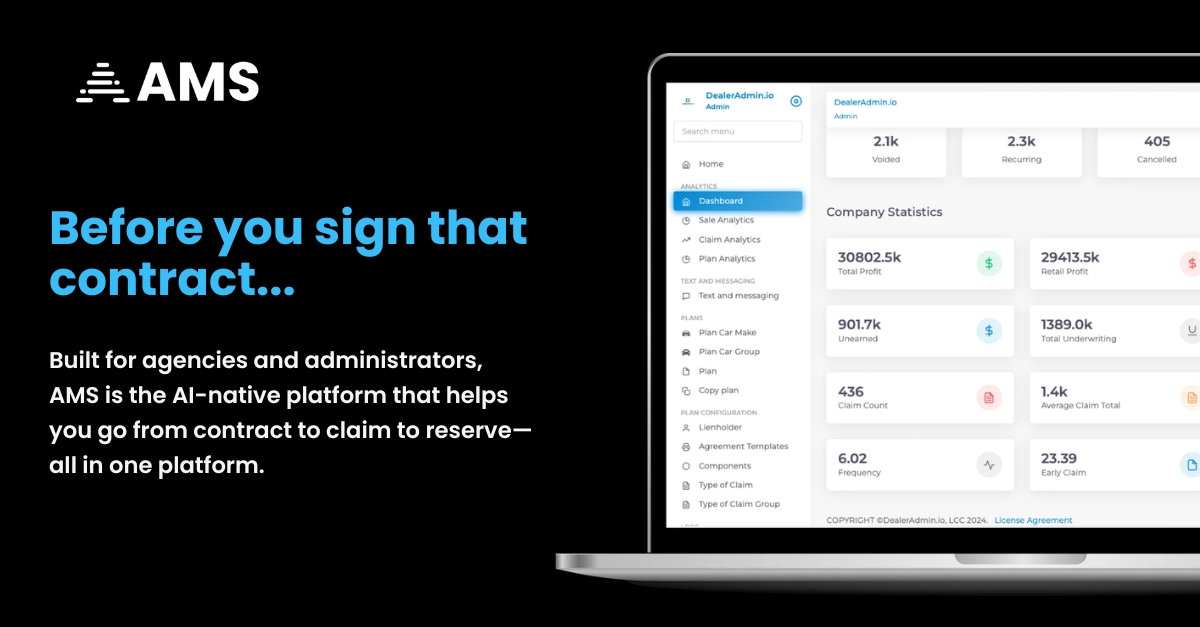
Built for agencies and administrators, AMS is the AI-native platform that helps you go from contract to claim to reserve, all in one platform.
BeYourOwnTPA.com was built primarily for F&I agencies, many of whom have never seriously considered self-administration as a realistic option, but are now asking that question for the first time as the market shifts around them. The site walks them through exactly what becoming their own TPA looks like in practice, operationally and financially, before they commit to anything. At the same time, administrators and agencies already in the market are finding that AMS gives them something legacy platforms caught in consolidation cannot: a stable, AI-native platform that keeps their operations running efficiently while the rest of the industry figures out what comes next. In both cases, the platform behind the answer is the same: built on AI from the ground up, not retrofitted to keep pace with where the industry is heading.
What the Market Is Saying
In conversations with F&I agencies and administrators across the country, including at the F&I Agent Summit this past April in Las Vegas, and in the outreach that has followed recent market consolidation, a consistent set of concerns has emerged about the direction legacy software platforms are heading:
Contract terms are getting longer and less flexible, while pricing floors are moving up. Businesses report being pressed into multi-year commitments, sometimes extending to five years, at higher minimums and with significantly reduced room to negotiate. Many have described renewal conversations that felt more aligned with vendor timelines than with their own readiness to commit.
Standard features are being sold as add-ons. Functionality that owners reasonably expect to be included, such as compliance tools, detailed reporting, and cession statements, is frequently offered as a separate paid tier layered on top of an already significant base contract. The cost of a fully functional platform can be dramatically higher than the headline price suggests.
Consolidation creates operational uncertainty for clients on both sides. When one platform acquires another, the clients of each face the same uncomfortable question: which system survives, which features carry over, and how long will the transition take? Administration companies and even agencies cannot afford to have their contract operations in limbo while software providers work through internal integration challenges at the client’s expense.
AI is being marketed where it hasn’t been built. Some platforms have announced AI capabilities that are, upon examination, provided by third-party vendors layered on top of existing legacy architecture, not embedded in the platform natively. The distinction matters: bolted-on intelligence does not behave the same way as a system built on AI from its foundation, potentially leaving data susceptible to major errors.
The perceived cost of switching has kept agencies from exploring their options. Large-scale platform migrations carry real costs. For sizable operations, those costs can reach well into the seven figures. That reality has historically kept administrators locked into arrangements they’re dissatisfied with, simply because leaving felt more expensive than staying.
“The market has been telling us the same thing everywhere we go: administration companies and agencies feel like they don’t have a real choice. Our job is to make sure they know they do.”
“The growth we’re seeing is the market speaking. Agencies and administrators have been told for years that this is just how software works: long contracts, add-on fees, platforms that can’t keep up. We built AMS to prove that it doesn’t have to work that way, and the results our clients are achieving are making that case better than any pitch we could give.” – Bart Carpenter, CEO, AMS (Administration Management Solutions)
How AMS Is Built Differently
According to company leadership, AMS was designed specifically to address the gaps the market has consistently surfaced over the past several years. The growth the company is now recording, they say, reflects how widespread and unaddressed those gaps remain among the legacy platforms currently consolidating around them.
AI-Native From Day One. Unlike platforms that have retrofitted AI capabilities onto existing architecture, AMS was built on an AI-native foundation from its inception. Intelligence is embedded in how claims are processed, how compliance is managed, and how reporting is generated, not sourced from a third-party vendor or added as a module. The result is a platform that evolves as a unified system, with improvements benefiting every client automatically and without additional cost.
One Standalone System: No Acquisitions to Integrate, Nothing to Consolidate. AMS operates as a single, purpose-built platform with no acquired systems running alongside it and no legacy architecture underneath it. For clients, that means no uncertainty about which features or data sets survive a merger, no disruption from integration timelines, and no back-end complexity inherited from a deal done at the corporate level.
Transparent, Inclusive Pricing. The AMS platform includes its core feature set under a single price structure. Compliance tools, reporting, and cession statements are part of the platform, not separate line items billed on top of a base contract. The company reports that this pricing model has been a consistent differentiator in conversations with administrators who have grown accustomed to building their budgets around unpredictable add-on fees.
Self-Administration Within Reach for Agencies Who Never Thought It Was Possible. Among the more notable trends in AMS’s recent growth is the number of F&I agencies successfully making the transition to self-administration, a step many assumed required a significantly larger operation to execute. The platform’s efficiency, according to the company, changes that calculation. Agencies that move to AMS have eliminated or dramatically reduced the third-party administrator fees they had been paying for years, and a number have gone further, including reselling the platform within their own networks and converting a former overhead expense into a revenue-generating capability.
Measurable Efficiency Gains for Administrators Already in the Market. For administrators already self-administering, AMS is delivering a different category of result: the ability to run the same operation with materially less overhead. The company reports that clients have demonstrated meaningful improvements in net-to-gross performance, moving from the mid-to-upper-30s typical of legacy-administered operations toward 50 percent and in some cases, above. The platform’s automation reduces the headcount dependency that has historically defined the administration model, allowing operations to scale without proportional increases in staff or infrastructure.
“The F&I industry has been underserved by platforms built for a different era. We’re not offering a modernized version of what agencies already have; we’re offering something genuinely different, and the results our clients are seeing prove it.” – Mark Visotsky, Chief Financial Officer, AMS (Administration Management Solutions)
AMS vs. Legacy Consolidation Platforms: A Direct Comparison
| Legacy Consolidation Platforms | AMS | |
| Platform Architecture | Legacy foundation with AI capabilities added on top after the fact | AI-native, built from the ground up with no add-ons required |
| Pricing Model | Base contract plus significant à la carte add-on fees | All core features included in a single platform price |
| Compliance Tools | Separate paid tier, billed monthly on top of base cost | Included, no additional charge |
| Reporting & Cession Statements | Separate paid tier, billed monthly on top of base cost | Included, no additional charge |
| Contract Terms | Multi-year lock-ins at rising minimum commitments | Flexible, transparent agreements built around client needs |
| System Complexity | Multiple platforms post-acquisition navigating consolidation | Single, standalone, purpose-built platform with no merger to absorb |
| Net-to-Gross Performance | Mid-to-upper 30s typical for legacy-administered operations | Clients targeting 50%+ through automation and efficiency gains |
| Reseller Opportunity | Not available | Agencies can resell, converting a cost center into a revenue stream |
A Growing Alternative in a Consolidating Market
Industry observers note that the timing of AMS’s growth is not coincidental. Agencies and administrators that have operated on legacy platforms for years are now evaluating their options with a seriousness that, by most accounts, has not been seen before in the F&I software segment. The consolidation activity driving that reassessment shows no sign of slowing, and the window for agencies to make a change before their next long-term contract commitment closes is narrowing.
AMS reports that it is actively engaged with agencies and administrators approaching renewal decisions, as well as those evaluating a first-time move to self-administration. The company offers platform demonstrations on request and works directly with prospective clients to model the financial impact of a transition ahead of any commitment.
For agencies exploring self-administration for the first time, BeYourOwnTPA.com offers educational resources, a downloadable F&I Agency Guide, and direct access to the AMS team, built specifically for agency leadership that wants to understand what becoming their own TPA looks like in practice before making any decisions.
“When we sit down with admin companies and agencies to walk through the numbers side by side: what they’re currently paying versus what their operation looks like on AMS. The conversation changes quickly. The financial case is compelling, and we’re happy to show anyone the math.” – Mark Visotsky, Chief Financial Officer, AMS (Administration Management Solutions)
See What a Better Option Looks Like.
Request a platform demonstration before your next contract decision.
BeYourOwnTPA.com
About Administration Management Solutions (AMS)
Administration Management Solutions (AMS) is an AI-native F&I administration platform headquartered in Windcrest, Texas. Built from the ground up to solve core industry problems, AMS has grown rapidly by enabling two distinct groups to achieve results legacy platforms have been unable to deliver: established administrators running leaner, more efficient operations at significantly lower cost, and F&I agencies making the transition to self-administration for the first time. AMS serves agencies and administrators across the United States seeking a modern, standalone alternative to legacy F&I software platforms. For more information, visit BeYourOwnTPA.com.
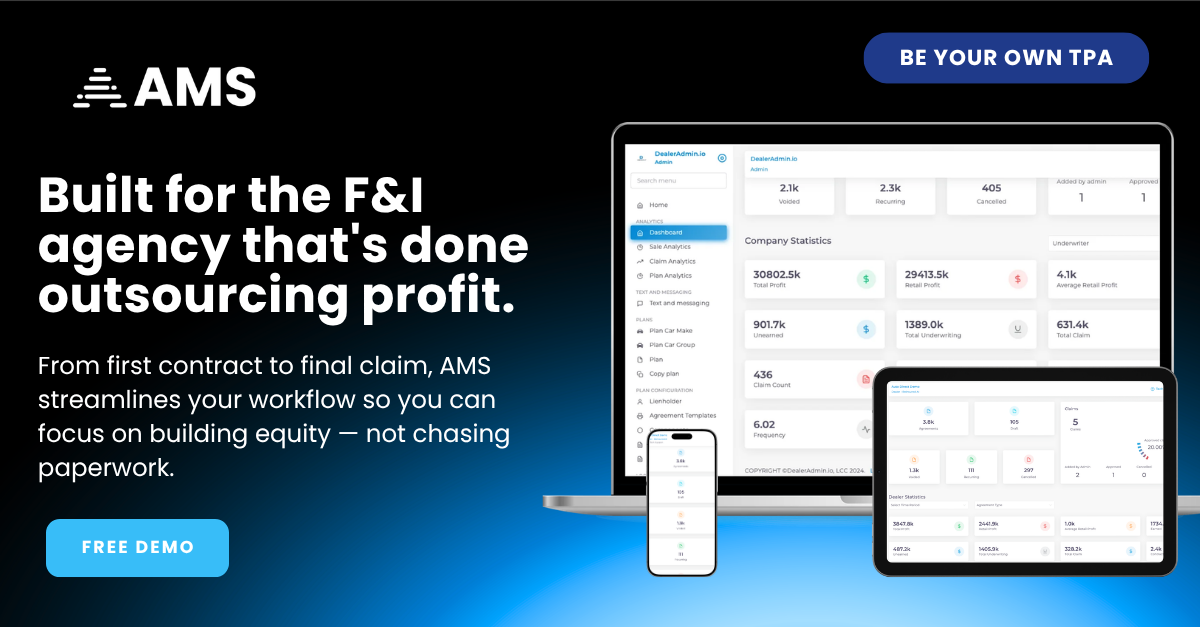
From first contract to final claim, AMS streamlines your workflow so you can focus on building equity — not chasing paperwork.
Press Inquiries
Mike Free
Sales@DealerAdmin.io
(210) 864-1344
https://beyourowntpa.com
8940 Fourwinds Drive Suite 610
Windcrest, TX 78239
A video accompanying this announcement is available here: https://youtube.com/watch?v=Nf695gQ2BBI