MONTRÉAL, QUÉBEC / ACCESS Newswire / May 21, 2026 / Critical Elements Lithium Corporation (TSX-V:CRE)(OTCQX:CRECF)(FSE:F12) (“Critical Elements” or the “Corporation”) is pleased to provide the last assay results and an update on its Phase 1 Winter 2026 drill program, at the 100% owned Rose West Discovery (“Rose West“), located in Eeyou Istchee, Québec.
Highlights
-
The Phase 1 Winter 2026 drill program has delivered positive results demonstrating the successful expansion of the Rose West mineralized footprint from 450 m x 370 m to 1,250 m x 800 m, thicknesses that typically range from 10 to 40 m, and excellent lateral grade continuity.
-
Newly discovered Pegmatite 5 is delivering substantial and laterally continuous intersections in the southern portion of the Main Target Area, part of a stacked and generally flat lying system.
-
The geological model continues to prove to be highly effective and productive.
-
Preparation is underway for an upcoming follow-up Summer 2026 Drilling Program.
Assay results were received for the four remaining holes RW-26-38 to 40, and RW-26-43, and returned some significant lithium and tantalum composite assays, as highlighted below:
-
1.03% Li2O and 233 ppm Ta2O5 over 14.65 m (including 1.68% Li2O and 224 ppm Ta2O5 over 8.25 m), through Pegmatite 2, in hole RW-26-38
-
1.71% Li2O and 210 ppm Ta2O5 over 14.75 m (including 2.47% Li2O and 165 ppm Ta2O5 over 8.05 m), through Pegmatite 3, in hole RW-26-39
-
0.98% Li2O and 121 ppm Ta2O5 over 11,20 m, through Pegmatite 5 (new), and
1.73% Li2O and 94 ppm Ta2O5 over 15.60 m (including 2.90% Li2O and 106 ppm Ta2O5 over 7.35 m), through Pegmatite 3, in hole RW-26-40 -
0.47% Li2O and 832 ppm Ta2O5 over 6.25 m (including 2.28% Li2O, 2,796 ppm Ta2O5 and 876 ppm Cs2O over 1.20 m), through Pegmatite 2, in hole RW-26-43
* Core length; the true thickness is between 80 to 95% of the core length.
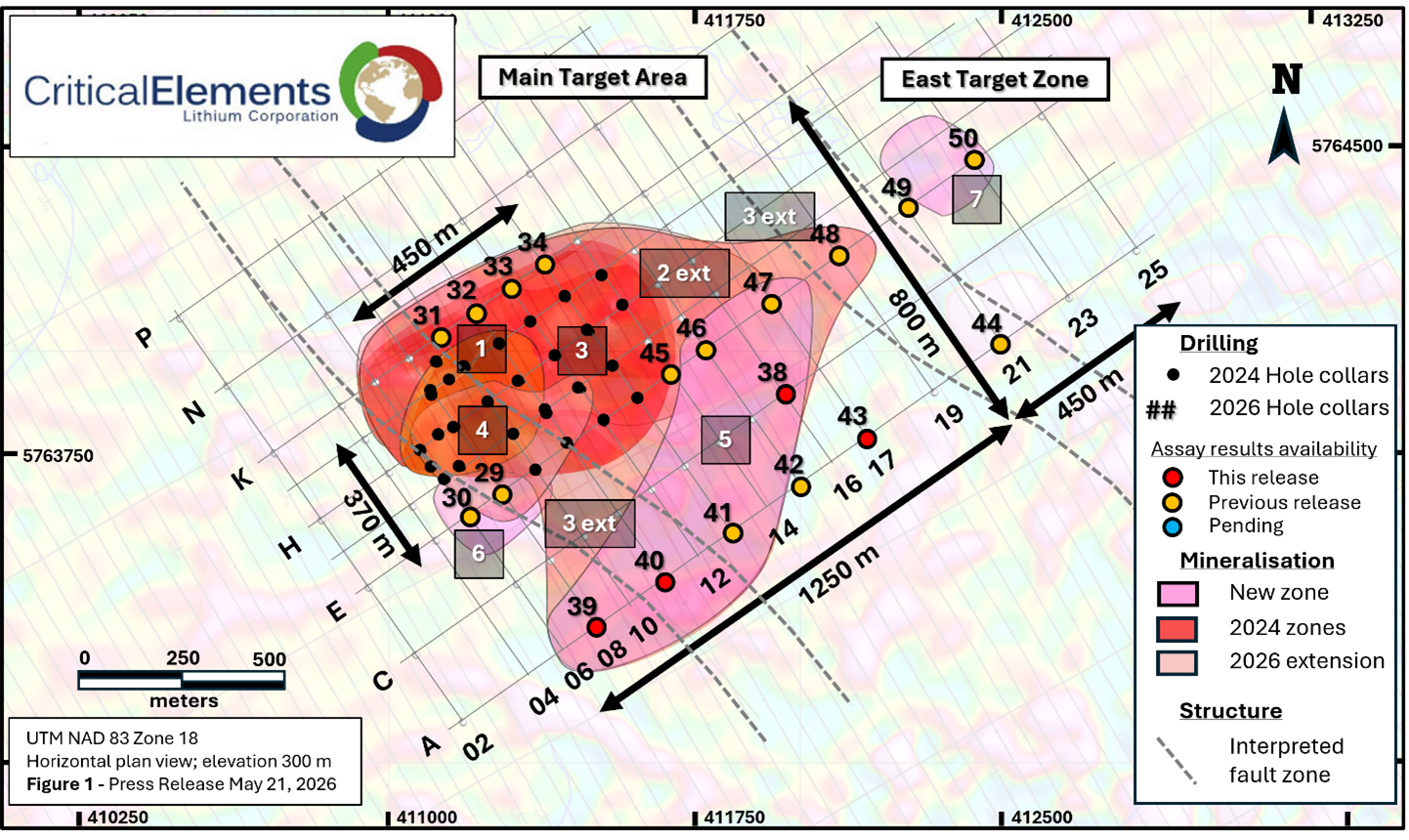
Rose West is situated within 10 km of the highly advanced Rose Lithium-Tantalum Project (“Rose“). Rose West is a near surface lithium-rich pegmatite bearing zone, initially intercepted by drilling over a 450 m x 370 m footprint area in the winter of 2024 (see Press Release dated February 3, 2026), now covering an overall footprint of 1,250 m x 800 m. The lithium-rich pegmatites typically range from 10 to 40 m in thickness and display a sub-horizontal geometry. Recent drilling has identified three (3) new spodumene-bearing pegmatitic bodies within the target area; a significant addition to the working model as it could potentially lead to rapid growth of the mineral inventory within the footprint of the project.
To date, the Winter 2026 drill program has covered most of the Line A, Line E and Line K planned holes (Figure 1). As previously mentioned, holes were planned to reach three specific goals:
-
Expand laterally all around the existing mineralized footprint (RW-26-29 to 34, RW-26-45 & 46);
-
Test the area for continuity to the northeast (RW-26-47 to 50), to the southeast (RW-26-40 to 44);
-
Verify the potential of discovering additional lithium-bearing pegmatites below the currently defined area.
Figure 1 below presents the 2026 collars location with, as well as the revised footprint on surface of the interpreted spodumene-rich pegmatitic dykes. Nineteen (19) holes have been drilled to date for a total of 4,037.75 meters. Table 1 presents the collar locations along with final length and the azimuth / dip of the holes drilled during this campaign.
Figure 1: Location map of the 2026 drillholes with respect to those from the winter 2024 campaign.
|
Drillhole |
Grid |
UTM NAD 83 ZN18 |
Length |
Azimuth |
Dip |
|
|
Position |
Easting |
Northing |
(m) |
(°) |
(°) |
|
|
RW-26-29 |
E-08 |
411277 |
5763656 |
207.00 |
245 |
-80 |
|
RW-26-30 |
E-06 |
411195 |
5763599 |
72.00 |
245 |
-70 |
|
RW-26-31 |
K-10 |
411129 |
5764041 |
126.00 |
245 |
-70 |
|
RW-26-32 |
K-11 |
411211 |
5764098 |
165.00 |
245 |
-70 |
|
RW-26-33 |
K-12 |
411293 |
5764156 |
287.70 |
245 |
-70 |
|
RW-26-34 |
K-13 |
411375 |
5764213 |
147.00 |
245 |
-70 |
|
RW-26-38 |
C-16 |
411965 |
5763893 |
218.90 |
245 |
-70 |
|
RW-26-39 |
A-08 |
411506 |
5763328 |
262.35 |
245 |
-70 |
|
RW-26-40 |
A-11 |
411670 |
5763443 |
195.00 |
245 |
-70 |
|
RW-26-41 |
A-13 |
411834 |
5763558 |
218.50 |
245 |
-70 |
|
RW-26-42 |
A-15 |
411998 |
5763673 |
9.00 |
245 |
-70 |
|
RW-26-43 |
A-17 |
412162 |
5763788 |
264.00 |
245 |
-70 |
|
RW-26-44 |
A-21 |
412489 |
5764017 |
301.90 |
245 |
-70 |
|
RW-26-45 |
E-14 |
411686 |
5763943 |
277.30 |
245 |
-80 |
|
RW-26-46 |
E-15 |
411768 |
5764000 |
222.00 |
245 |
-80 |
|
RW-26-47 |
E-17 |
411932 |
5764115 |
194.30 |
245 |
-70 |
|
RW-26-48 |
E-19 |
412096 |
5764230 |
207.00 |
245 |
-70 |
|
RW-26-49 |
E-21 |
412260 |
5764345 |
255.00 |
245 |
-70 |
|
RW-26-50 |
E-23 |
412423 |
5764459 |
407.8 |
245 |
-70 |
Table 1 – 2026 Winter drillholes location and summary description
Table 2 following presents the composite assay results from the Winter 2026 Drill Program. New and updated results presented in the current press release are highlighted in grey.
Hole RW-26-38 was drilled on Line C (Figure 1), and intersected two thin zones within the projection of the new Pegmatite 5 and did not intersect the projection of Pegmatite 3, likely marking a pinching of the zones at this location. Pegmatite 2 was intersected over 14.65 m lower down the hole, consistent with the reported thickness in holes drilled on Line K, 200 m to the north.
Holes RW-26-39 and RW-26-40 were drilled on Line A (Figure 2), along the southern extent of the initial mineralized area. The two (2) holes intersected two significant pegmatites interpreted to be Pegmatite 5 (new) and Pegmatite 3; both showing a thickness still in the range of 10-15 meters, and extending the footprint of the main Pegmatite 3 by approximately 500 m to the south. It is noticeable that Cesium oxide (Cs2O) grade appears to increase towards the south; from the usual 50-125 ppm Cs2O observed in the previous holes, both holes 39 and 40 show values ranging from 125 to 500 ppm, with spikes close to the 1,000 ppm threshold.
Hole RW-26-43, also on Line A, did not intersect the projection of neither Pegmatite 5 nor 3, but returned 0.47 % Li2O over 6.25 m through Pegmatite 2; extending the latter by an additional 100 m towards the East. Although relatively thin, this intersection returned very high Ta2O5 (832 ppm over 6.25 m, including 2,796 ppm over the length of a 1.20 m sample) as well as high values Cs2O, averaging 876 ppm over 6.25 m, and as high as 4,018 ppm (0.4 %) Cs2O along with 2.28 % Li2O over the length of the 1.20 m sample.
|
Drillhole |
From |
To |
Length |
Li2O |
Ta2O5 |
Zone |
|
(m) |
(m) |
(m) |
(%) |
(ppm) |
||
|
RW-26-29 |
12.60 |
16.20 |
3.60 |
1.51 |
242 |
4 |
|
176.95 |
192.00 |
15.05 |
0.77 |
170 |
6 (new) |
|
|
including |
180.00 |
188.00 |
8.00 |
1.39 |
111 |
6 (new) |
|
RW-26-30 |
3.45 |
6.40 |
2.95 |
0.40 |
239 |
4 |
|
RW-26-31 |
54.00 |
60.50 |
6.50 |
0.15 |
191 |
3 |
|
96.00 |
101.85 |
5.85 |
0.58 |
170 |
2 |
|
|
RW-26-32 |
39.00 |
52.50 |
13.50 |
1.89 |
207 |
3 |
|
105.10 |
110.85 |
5.75 |
0.79 |
208 |
n.a |
|
|
116.90 |
118.25 |
1.35 |
0.18 |
23 |
n.a |
|
|
RW-26-33 |
60.35 |
78.10 |
17.75 |
1.29 |
169 |
3 |
|
including |
63.00 |
72.00 |
9.00 |
2.13 |
105 |
3 |
|
122.05 |
123.60 |
1.55 |
0.01 |
432 |
2 |
|
|
RW-26-34 |
37.00 |
51.50 |
14.50 |
1.19 |
167 |
3 |
|
including |
37.00 |
49.20 |
12.20 |
1.41 |
170 |
3 |
|
RW-26-38 |
71.60 |
73.50 |
1.90 |
0.80 |
118 |
5 (new) |
|
83.70 |
85.60 |
1.90 |
0.30 |
137 |
n.a |
|
|
194.25 |
208.90 |
14.65 |
1.03 |
233 |
2 |
|
|
including |
194.25 |
202.50 |
8.25 |
1.68 |
224 |
2 |
|
RW-26-39 |
68.65 |
71.35 |
2.70 |
1.31 |
238 |
5 (new) |
|
112.05 |
126.80 |
14.75 |
1.71 |
210 |
3 |
|
|
including |
114.95 |
123.00 |
8.05 |
2.47 |
165 |
3 |
|
132.15 |
137.50 |
5.35 |
0.13 |
328 |
n.a. |
|
|
RW-26-40 |
26.20 |
27.90 |
1.70 |
0.03 |
303 |
n.a |
|
55.90 |
67.10 |
11.20 |
0.98 |
121 |
5 (new) |
|
|
104.40 |
120.00 |
15.60 |
1.73 |
94 |
3 |
|
|
including |
108.00 |
115.35 |
7.35 |
2.90 |
106 |
3 |
|
150.40 |
155.30 |
4.90 |
0.03 |
180 |
n.a |
|
|
RW-26-41 |
68.55 |
87.05 |
18.50 |
1.51 |
93 |
5 (new) |
|
including |
68.55 |
78.15 |
9.60 |
2.49 |
50 |
5 (new) |
|
112.00 |
122.00 |
10.00 |
0.89 |
175 |
3 |
|
|
189.70 |
192.85 |
3.15 |
0.02 |
258 |
n.a |
|
|
RW-26-42 |
– |
9.00 |
Abandoned |
|||
|
RW-26-43 |
204.95 |
211.20 |
6.25 |
0.47 |
832 |
2 |
|
including |
206.45 |
207.65 |
1.20 |
2.28 |
2,796 |
2 |
|
RW-26-44 |
– |
301.90 |
No significant results |
|||
|
RW-26-45 |
113.20 |
141.00 |
27.80 |
1.27 |
111 |
3 |
|
including |
119.00 |
141.00 |
22.00 |
1.43 |
122 |
3 |
|
163.25 |
175.90 |
12.65 |
1.00 |
192 |
2 |
|
|
RW-26-46 |
70.60 |
81.05 |
10.45 |
0.93 |
291 |
5 (new) |
|
including |
72.00 |
75.00 |
3.00 |
2.75 |
553 |
5 (new) |
|
125.60 |
138.20 |
12.60 |
2.18 |
68 |
3 |
|
|
including |
126.60 |
134.00 |
7.40 |
3.11 |
48 |
3 |
|
168.20 |
182.80 |
14.60 |
1.82 |
176 |
2 |
|
|
Including |
168.20 |
178.70 |
10.50 |
2.42 |
146 |
2 |
|
RW-26-47 |
69.30 |
79.60 |
10.30 |
1.72 |
117 |
5 (new) |
|
Including |
70.25 |
76.60 |
6.35 |
2.61 |
117 |
5 (new) |
|
140.15 |
151.90 |
11.75 |
1.91 |
74 |
3 |
|
|
165.25 |
175.60 |
10.35 |
1.44 |
266 |
n.a |
|
|
188.05 |
193.25 |
5.20 |
1.68 |
101 |
2 |
|
|
RW-26-48 |
130.50 |
138.60 |
8.10 |
0.59 |
200 |
3 |
|
168.65 |
175.90 |
7.25 |
0.03 |
156 |
2 |
|
|
RW-26-49 |
158.55 |
160.65 |
2.10 |
0.01 |
110 |
3 |
|
RW-26-50 |
328.20 |
341.10 |
12.90 |
1.13 |
109 |
7 (new) |
|
Including |
328.20 |
335.45 |
7.25 |
1.67 |
108 |
7 (new) |
* Core length; the true thickness is between 80 to 95% of the core length.
** Zone; n.a refers to “not assigned” to a given interpreted mineralized zone.
*** New and updated results are highlighted in grey.
Table 2 – Spodumene-rich pegmatite intervals and assay results from the Winter 2026 drill campaign.
Figure 2: Vertical section – Line A; looking northwest
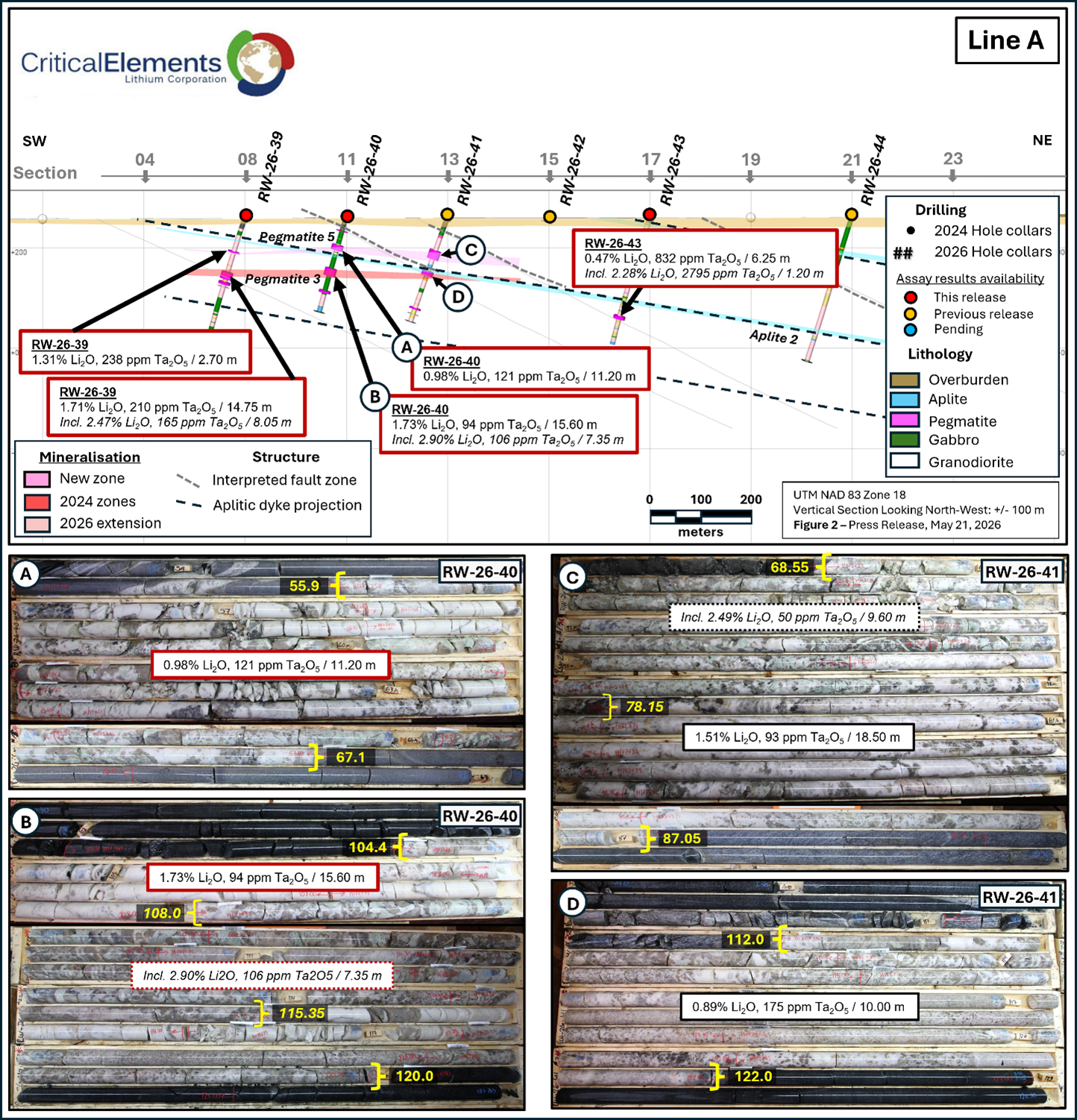
Photos 2A and 2C show a new pegmatitic zone (Zone 5), and photos 2B and 2D are examples of the main pegmatite (Zone 3) aspect in core.
Figure 3: Vertical section – Line E; looking northwest
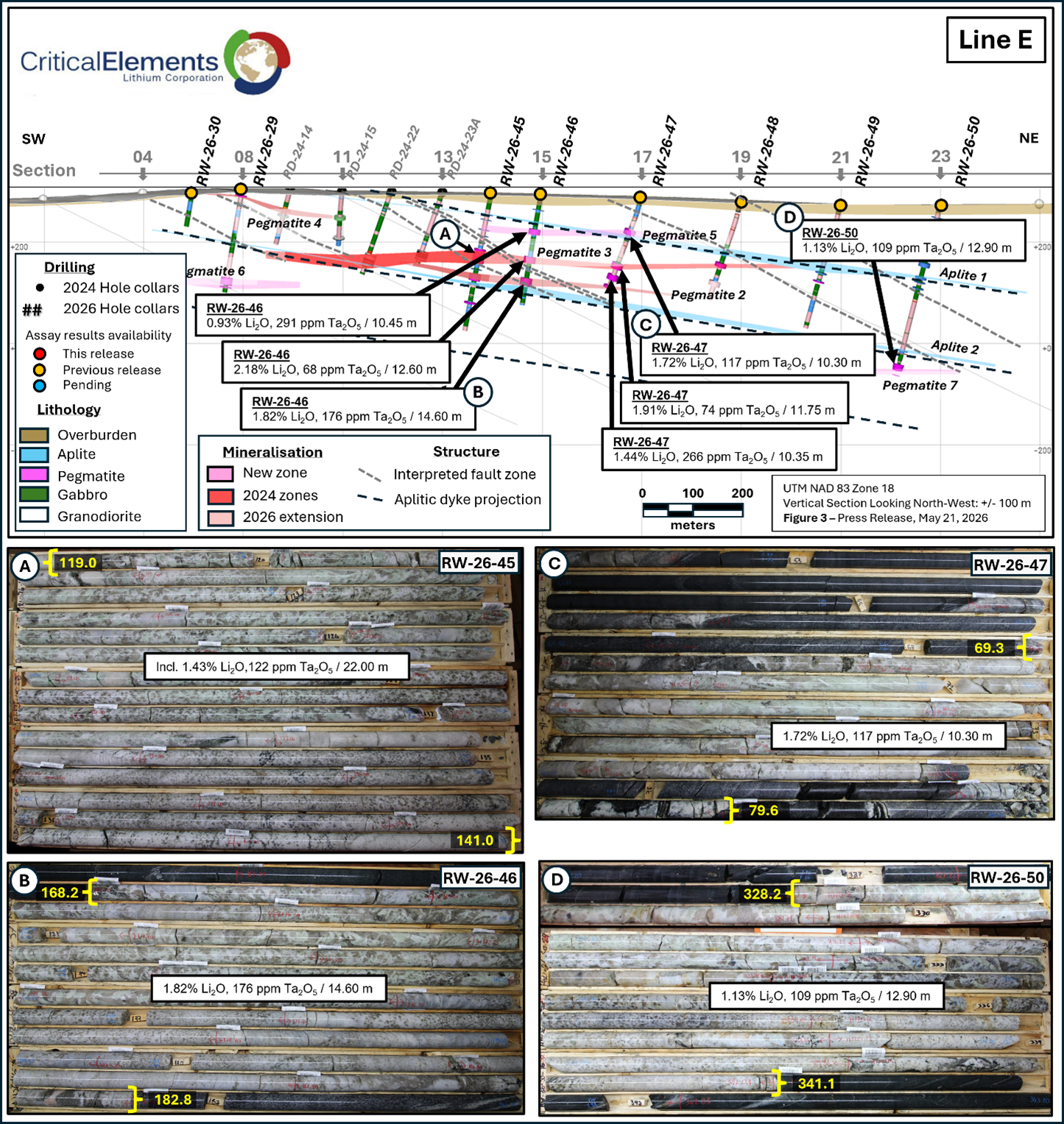
Photo 3A from hole RW-26-45 represents the widest intersection of the current campaign. Photo 3B is an example of Zone 2. Photos 3C and 3D show the new Zone 5 and Zone 7 respectively.
Figure 4: Vertical section – Line K; looking northeast
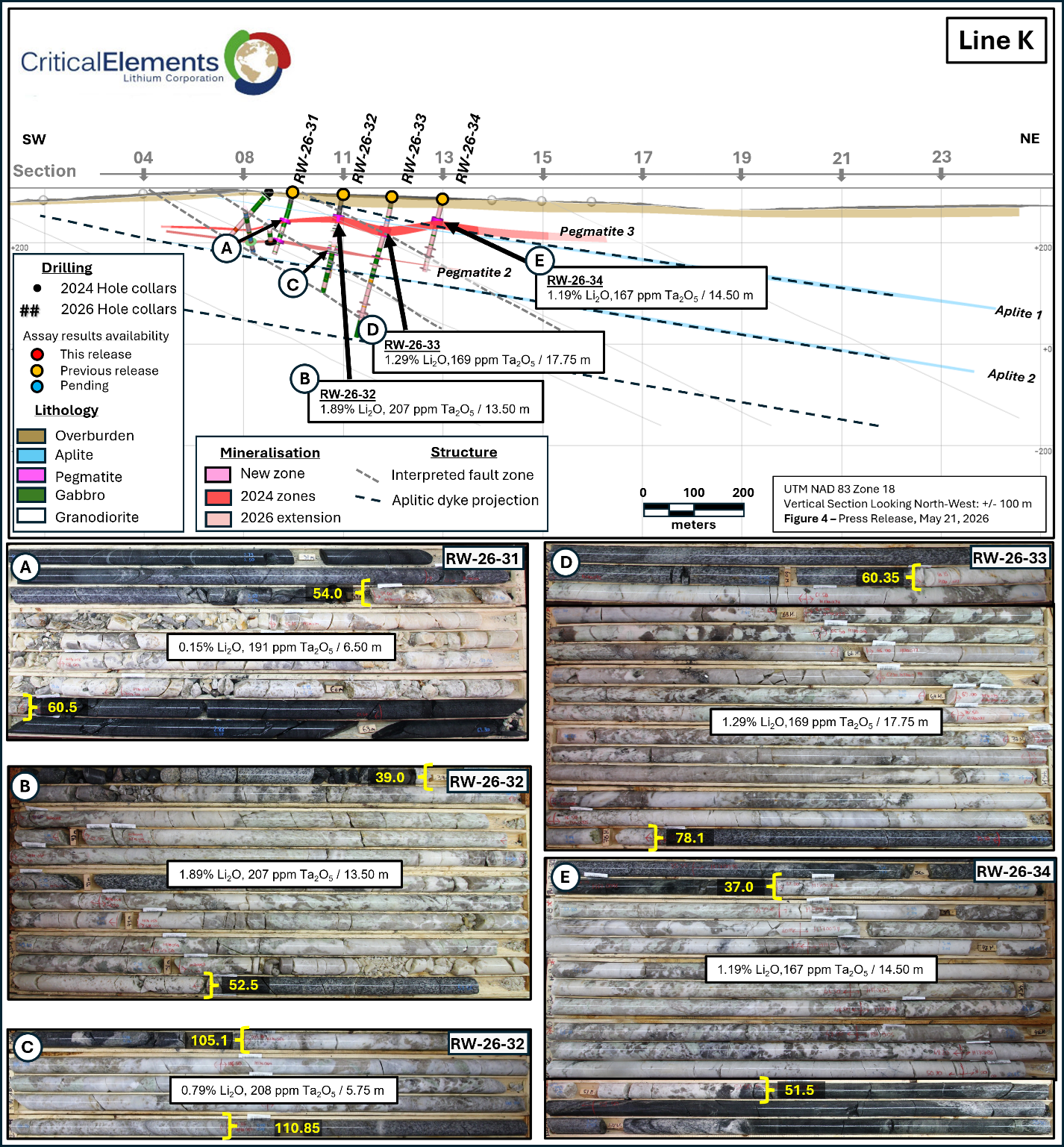
Core photos 4A, 4B, 4D and 4E are all examples of the main Zone 3 pegmatite. Photo 4C presents a thinner intersection through Zone 2.
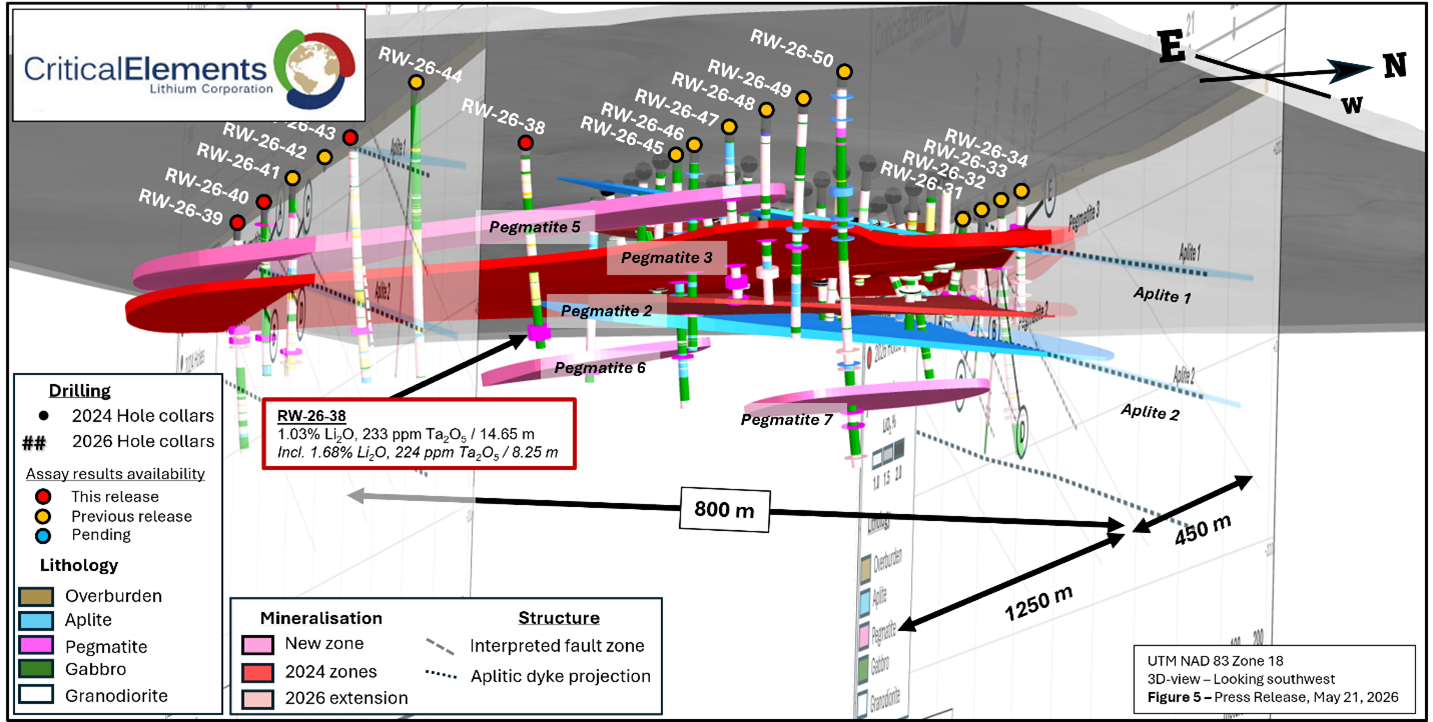
The Winter 2026 drill campaign ended April 3rd, and all assay results of the samples sent to the laboratory are now available and presented in the current press release. The campaign has proven to be successful by demonstrating the lateral continuity of the mineralization, and interpretation of the mineralized model has been completed to the extent of the available data. Figure 5 below shows a 3D view looking up-plunge along the shallow structural corridor defined by aplitic dykes. The sub-horizontal pegmatites dykes are believed to be in an extensional position and distributed in a “en echelon” pattern within a much wider regional structural framework.
Figure 5: 3D view – looking southwest
“The drilling campaign has clearly met our initial goals; expanding the know mineralized volumes and demonstrating the lateral continuity of the grades in Lithium and Tantalum oxides. Work continues at refining our structural interpretation of the system to prepare for a follow up summer drilling program. We are confident in our 3D model which so far has proven to be predictive. We believe the model to be robust enough to start integrating geochemical data and run multi-elements interpolations within the structurally defined mineralized. We are hopeful that it could lead to better defining high grade mineralization vectors within the system”, commented Kenneth Williamson, Director of Exploration of the Corporation.
Quality assurance/quality control
Quality assurance and quality control procedures have been implemented to ensure best practices in sampling and analysis of the drill core samples. Standards, duplicate and blanks were regularly inserted into the sample stream. The drill core samples were delivered, in secure tagged bags to the ALS Minerals laboratory facility in Val-d’Or, Québec. The samples are weighed and identified prior to sample preparation. The samples are crushed to 70% minus 2 mm, then separated and pulverized to 85% passing 75 μm. All samples are analyzed using sodium peroxide fusion ME-MS-89L, with full analysis for 52 elements. Value over 25,000 ppm Li were re-assays using Li-ICP-82b and value over 2,500 ppm Ta2O5 were re-assays using Ta-XRF10.
Qualified Person
Kenneth Williamson, Géo, M.Sc. Director of Exploration at Critical Elements, is the Qualified Person that has reviewed and approved the technical contents of this news release on behalf of the Corporation.
About Critical Elements Lithium Corporation
Critical Elements aspires to become a large, responsible supplier of lithium to the flourishing electric vehicle and energy storage system industries. To this end, Critical Elements is advancing the wholly-owned, high-purity Rose Lithium-Tantalum project in Québec, the Corporation’s first lithium project to be advanced within a land portfolio of over 1,016 km2. On August 29, 2023, the Corporation announced results of a new Feasibility Study on Rose for the production of spodumene concentrate. The after-tax internal rate of return for the Project is estimated at 65.7%, with an estimated after-tax net present value of US$2.2B at an 8% discount rate. In the Corporation’s view, Québec is strategically well-positioned for US and EU markets and boasts good infrastructure including a low-cost, low-carbon power grid featuring 94% hydroelectricity. The project has received approval from the Federal Minister of Environment and Climate Change on the recommendation of the Joint Assessment Committee, comprised of representatives from the Impact Assessment Agency of Canada and the Cree Nation Government, received the Certificate of Authorization under the Environment Quality Act from the Québec Minister of the Environment, the Fight against Climate Change, Wildlife and Parks, and the project mining lease from the Québec Minister of Natural Resources and Forests under the Québec Mining Act.
For further information, please contact:
Jean-Sébastien Lavallée, P. Géo.
Chief Executive Officer
819-354-5146
jslavallee@cecorp.ca
www.cecorp.ca
Neither the TSX Venture Exchange nor its Regulation Services Provider (as that term is described in the policies of the TSX Venture Exchange) accepts responsibility for the adequacy or accuracy of this release.
Cautionary statement concerning forward-looking statements
This news release contains “forward-looking information” within the meaning of Canadian Securities legislation. Generally, forward-looking information can be identified by the use of forward-looking terminology such as “scheduled”, “anticipates”, “expects” or “does not expect”, “is expected”, “scheduled”, “targeted”, or “believes”, or variations of such words and phrases or statements that certain actions, events or results “may”, “could”, “would”, “might” or “will be taken”, “occur” or “be achieved”. Forward-looking information contained herein include, without limitation, statements relating to the anticipated receipt of the final assay results from the 2026 drilling program on the Corporation’s Rose West property, the results and completion of the 2026 exploration drilling program and its related objectives. Forward-looking information is based on assumptions management believes to be reasonable at the time such statements are made. There can be no assurance that such statements will prove to be accurate, as actual results and future events could differ materially from those anticipated in such statements. Accordingly, readers should not place undue reliance on forward-looking information.
Although Critical Elements has attempted to identify important factors that could cause actual results to differ materially from those contained in forward-looking information, there may be other factors that cause results not to be as anticipated, estimated or intended. Factors that may cause actual results to differ materially from expected results described in forward-looking information include, but are not limited to: delays in obtaining final assay results from the laboratory facility, the final and complete results of the Corporation’s 2026 exploration drilling program on the Corporation’s Rose West property not delivering the anticipated results and the effects on the Corporation’s stated objectives, as well as those risk factors set out in the Corporation’s Management Discussion and Analysis for its most recent quarter ended February 28, 2026 and other disclosure documents available under the Corporation’s SEDAR+ profile. Forward-looking information contained herein is made as of the date of this news release and Critical Elements disclaims any obligation to update any forward-looking information, whether as a result of new information, future events or results or otherwise, except as required by applicable securities laws.
Forward-looking information contained herein is made as of the date of this news release. Although the Corporation has attempted to identify important factors that could cause actual results to differ materially from those contained in the forward-looking information or implied by forward-looking information, there may be other factors that cause results not to be as anticipated, estimated or intended. Accordingly, readers should not place undue reliance on forward-looking statements or information. The Company undertakes no obligation to update or reissue forward-looking information as a result of new information or events except as required by applicable securities laws.
SOURCE: Critical Elements Lithium Corp.
View the original press release on ACCESS Newswire