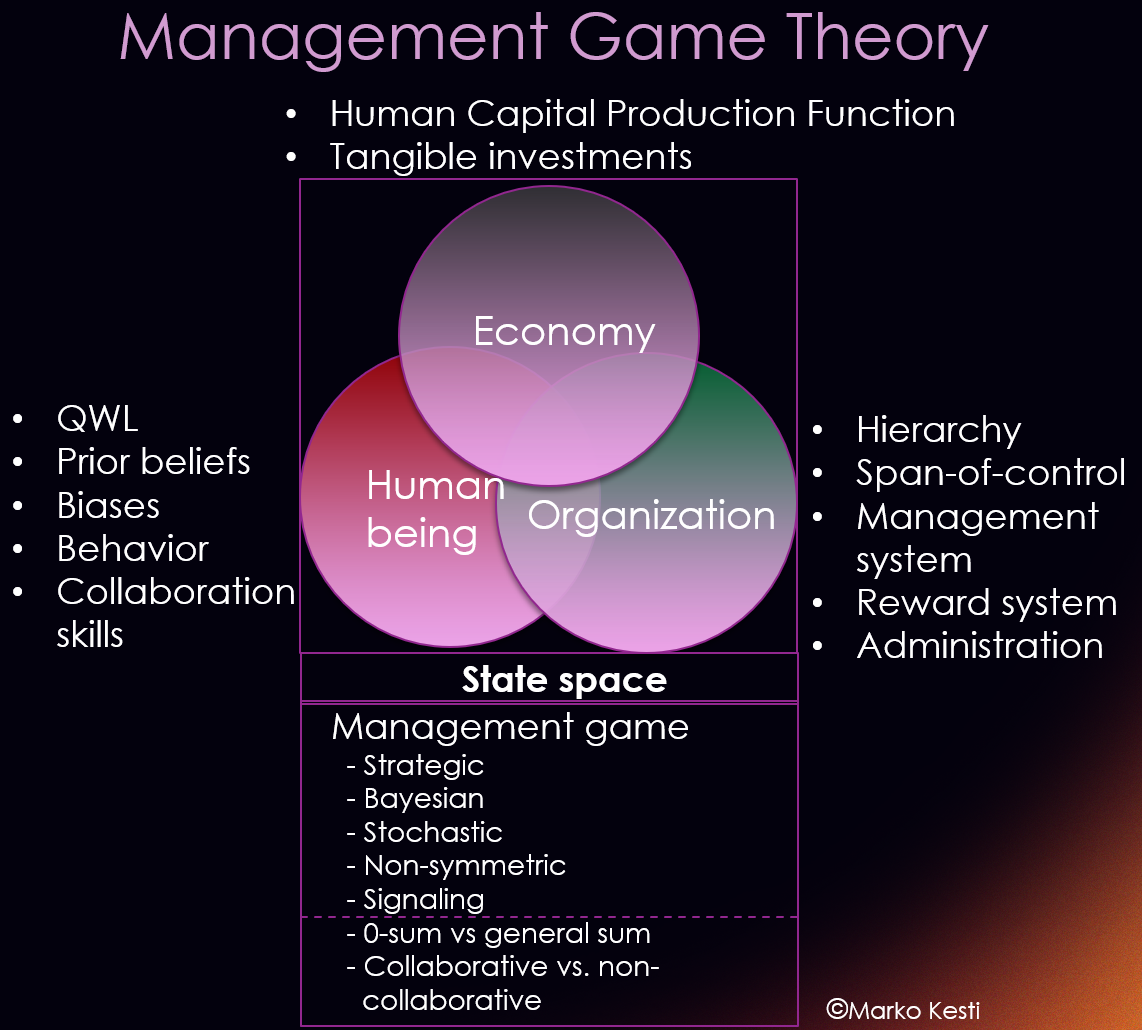
Dr. Marko Kesti introduces a game-theoretical model that treats emotional safety as strategic information infrastructure, and variance indicator of team health.
OULU, FINLAND, June 12, 2026 /EINPresswire.com/ — Researcher Marko Kesti introduces a game-theoretical model that treats psychological safety as strategic information infrastructure — and variance, not average, as the true indicator of team health.
A theoretical framework developed by researcher Marko Kesti, University of Lapland, proposes a fundamental shift in how leadership and team dynamics are understood and measured. The framework, called Management Game Theory, combines game theory, Bayesian decision-making, and quality of working life (QWL) measurement to offer organizations a practical diagnostic tool for identifying hidden dysfunctions before they become crises.
The framework extends Kesti’s peer-reviewed work in Deep Learning Applications (IntechOpen, 2021), where he introduced the Organization Digital Twin: a reinforcement learning AI system in which agents learn leadership behaviors that sustain Nash equilibrium between business performance and staff wellbeing. The current article develops the QWL-based measurement architecture — playing field coordinates, experiential asymmetry, and variance trajectory — into a standalone diagnostic tool applicable without AI simulation.
Leadership as a Strategic Signaling Game
At the core of the framework is a precise definition: leadership is a strategic, stochastic, Bayesian, asymmetric signaling game, played within a state space defined by three intersecting systems — the economy, human behavior, and organizational structure.
“Every action by a leader is simultaneously a decision and a signal,” Kesti explains. “It shapes how employees interpret the playing field and whether they choose to share honest information upward.”
The framework identifies psychological safety not merely as a well-being factor, but as strategic information infrastructure. When psychological safety is low, employees filter their signals. The leader makes Bayesian decisions on distorted data, without knowing the distortion exists — a self-reinforcing downward loop.
The Playing Field: Two Dimensions, Three Factors
The framework maps each team member’s position on a two-dimensional playing field with a third energy dimension:
The X-axis captures the game’s sum structure: zero-sum (one player’s gain is another’s loss) versus positive sum (shared gains are possible). The Y-axis captures social cohesion: collaborative versus non-collaborative. A third dimension — energy and proactivity — reflects the degree to which work is experienced as meaningful and creative.
These three dimensions correspond directly to three QWL motivational factors: PE (physical and emotional safety), SC (social cohesion), and PC (purpose and creativity). Each employee receives a coordinate on the playing field — X = (PE + PC) / 2, Y = SC — making abstract game dynamics measurable and comparable across time.
“When an employee scores high on PE and SC but low on PC, the diagnosis is clear,” Kesti notes. “Safety and community are in place, but the work itself lacks meaning. The leadership intervention is targeted: not culture-building, but purpose and creative challenge.”
The Hidden Problem: Zero-Sum Players Are Invisible to Standard Measurement
One of the framework’s most significant theoretical contributions addresses a blind spot in conventional team assessment. A zero-sum player — someone whose behavior systematically undermines others’ wellbeing while advancing their own position — may score among the highest on individual QWL measures. They may feel safe, socially connected, and purposeful. Their data looks exemplary.
“Standard measurement captures individual experience. It cannot capture what one person’s behavior does to others’ experience,” Kesti explains. “This is where experiential asymmetry becomes the key diagnostic concept.”
Experiential asymmetry refers to the condition in which members of the same team perceive the playing field in fundamentally different ways. It is measured not by averages but by standard deviation across QWL factors. High variance is not a measurement error — it is a signal that multiple games are being played simultaneously within the same team.
The zero-sum player becomes visible not through individual scores, but through the variance those scores contribute to. When one member experiences high cohesion while others experience isolation, the divergence itself points to the dynamic — without naming or blaming any individual.
Response Rate as a Signal
A methodological finding with direct practical implications: survey response rate is itself diagnostic data. In a longitudinal case study of a healthcare team, the team achieved 100% response rate immediately following a workplace mediation process — a period when all QWL averages also peaked. At the next measurement point, response rate fell back to 58%, with averages declining and variance expanding sharply.
“Those who went silent were almost certainly those with the worst experiences, thus the data we have is optimistic,” Kesti notes. “Response rate tracks psychological safety and meaning.”
Variance Trajectory as the True Leadership Metric
The framework proposes that the movement of variance over time — not the level of averages — is the most precise measure of leadership quality. Four scenarios define the diagnostic space:
When variance decreases while averages rise, the team is converging toward positive-sum, collaborative play — the optimal trajectory. When variance decreases while averages fall, the team is converging downward: zero-sum logic has spread across the whole group. When variance increases while averages rise, fast-developing members are pulling ahead of others — experiential asymmetry is growing and requires monitoring. When variance remains persistently high regardless of average movement, current interventions are not working, and structural conditions within the state space may be blocking change.
State Space: Why Some Problems Cannot Be Solved at the Team Level
The state space concept explains why the same intervention produces different results in different contexts. It also clarifies the blunging-in bias: a leader acts quickly on a visible symptom while misidentifying its root cause. Chronic understaffing cannot be resolved by culture work. Distinguishing state-space constraints from playing-field problems is a prerequisite for effective action.
Implications for Organizations
The framework gives organizations a four-part measurement architecture: individual QWL factors map playing field position; team-level variance measures experiential asymmetry; response rate proxies psychological safety; and variance trajectory over time is the primary indicator of leadership effectiveness.
The framework has been validated through longitudinal QWL data across three measurement points in a Finnish healthcare organization.
________________________________________
About the Author
Marko Kesti is CEO at Novogain and a researcher at the University of Lapland, Rovaniemi, Finland, specializing in human capital management and organizational performance.
Kesti Marko Playgain Oy
Novogain (Playgain Inc)
+358 407178006
email us here
Visit us on social media:
LinkedIn
YouTube
Novogain AI short presentation and contact information
Legal Disclaimer:
EIN Presswire provides this news content “as is” without warranty of any kind. We do not accept any responsibility or liability
for the accuracy, content, images, videos, licenses, completeness, legality, or reliability of the information contained in this
article. If you have any complaints or copyright issues related to this article, kindly contact the author above.

Media gallery