
Pathway, an AI lab building a Post-Transformer architecture and models, today published benchmark results for BDH-CQ, a 150-million-parameter reasoning model. BDH-CQ scored 29.5% pass@2 on the public ARC-AGI-1 evaluation set at a computed inference cost of $0.0007 per task. Thanks to a new approach to reasoning, BDH-CQ runs approximately 11 times as cheaply per task as GPT 5.6 Luna (Low), even after accounting for OpenAI’s 80% price cut of 5.6 Luna on July 30th. Luna scores 34.2% against BDH-CQ’s 29.5%, a modest accuracy gain at 11 times the cost.
This press release features multimedia. View the full release here: https://www.businesswire.com/news/home/20260811268264/en/
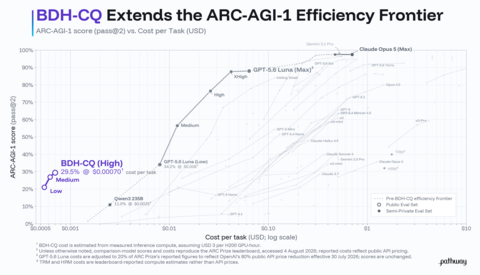
ARC-AGI-1 score versus estimated cost per task alongside official ARC Prize leaderboard results as of July 31, 2026. The reported score surpasses the previously reported cost-accuracy Pareto frontier, setting a new benchmark for ARC-AGI-1 cost efficiency.
ARC-AGI-1 is a public reasoning benchmark that tests whether a system can infer an underlying rule from a small number of examples and apply it to a new input, a capability often associated with human-like intelligence.
The cost gap comes from a structural difference. Many transformer-based reasoning systems externalize their work as a chain-of-thought, generating extra tokens sequentially and feeding them back into later steps. As the trace grows, so do inference cost and latency, significantly. BDH-CQ instead performs this work in a recurrent latent state, learning from examples and refining a solution without generating an intermediate text trace. It thinks natively rather than using an intermediate-language scratchpad.
“Today’s AI pays a steep token cost for reasoning, but that cost is imposed by architecture, not by any law of intelligence. Currently, every reasoning step consumes context, adds latency, and burns compute. We show that a different architecture changes the game and opens up a whole new space in terms of how much intelligence per dollar. A 150M-parameter model, built on Pathway’s BDH architecture, reasons recurrently in latent space, and sets a new state of the art in cost efficiency on ARC-AGI-1. The bottleneck was never intelligence. It was design,” said Zuzanna Stamirowska, CEO and co-founder of Pathway.
Scores and comparison costs are drawn from the ARC Prize Foundation’s public leaderboard, which plots each submitted system’s benchmark score against its cost per task, as of July 2026. Pathway’s cost is computed from measured hardware time. Comparison costs are those reported to the leaderboard and may reflect API pricing for generalist models.
BDH’s ARC-AGI-1 results were evaluated by Łukasz Kaiser, a co-author of the 2017 paper that introduced the Transformer architecture, who said, “I’ve followed Pathway closely and replicated their ARC-AGI-1 results myself. Pathway shows that model architecture, not just scale, can drive the next leap in AI reasoning.”
The results were also reproduced by Richard Zhong, an NYU researcher focused on model evaluation and benchmark robustness and a co-author from Bielik.
Pathway plans to scale the architecture next and extend the approach to more challenging reasoning benchmarks such as mathematical reasoning, ARC-AGI-2, and ARC-AGI-3, and to build a latent reasoning Large Language Model. When its efficiency and state-tracking capabilities extend to those domains, BDH will support a wide range of applications that must reason reliably as information and constraints change, from cybersecurity incident response to real-time industrial operations. Early experiments confirm Transformer-like scaling laws apply during pretraining at scales from 1B to 600B parameters, while preserving the latent reasoning capabilities specific to BDH-CQ.
The full paper and methodology are available at http://pathway.com/research/introducing-bdh-cq/arc-agi-1.
About Pathway
Pathway is an AI lab building Post-Transformer model architecture. Its BDH architecture keeps memory and reasoning inside the model rather than in a growing context window, an approach aimed at systems that can adapt as information changes instead of starting from the same state on every use.
Pathway is led by co-founder and CEO Zuzanna Stamirowska, a complexity scientist, alongside CTO Jan Chorowski, previously a researcher at Google Brain, and CSO Adrian Kosowski, a computer scientist who completed his PhD at 20. The company is backed by investors and advisors including Łukasz Kaiser, a co-author of the paper that introduced the transformer architecture. Pathway is headquartered in Palo Alto, California.
View source version on businesswire.com: https://www.businesswire.com/news/home/20260811268264/en/
Media gallery


