
Key Takeaways
- A profitable-looking P&L and an empty bank account can happen at the same time, and most restaurant owners never find out why until the money runs short.
- Net free cash flow, not net profit, answers a more useful question: what can actually be taken home after the business pays for everything it truly owes.
- Running only 2 to 3 percent over on prime cost can quietly drain tens of thousands of dollars a year from a restaurant that looks fine on paper.
- Fixing financial problems in the wrong order can add extra work without adding a single dollar to the bank account.
- Expansion multiplies whatever is already leaking, so a restaurant with cash flow problems at one location often finds those problems compounded at multiple.
Where Did All the Money Go?
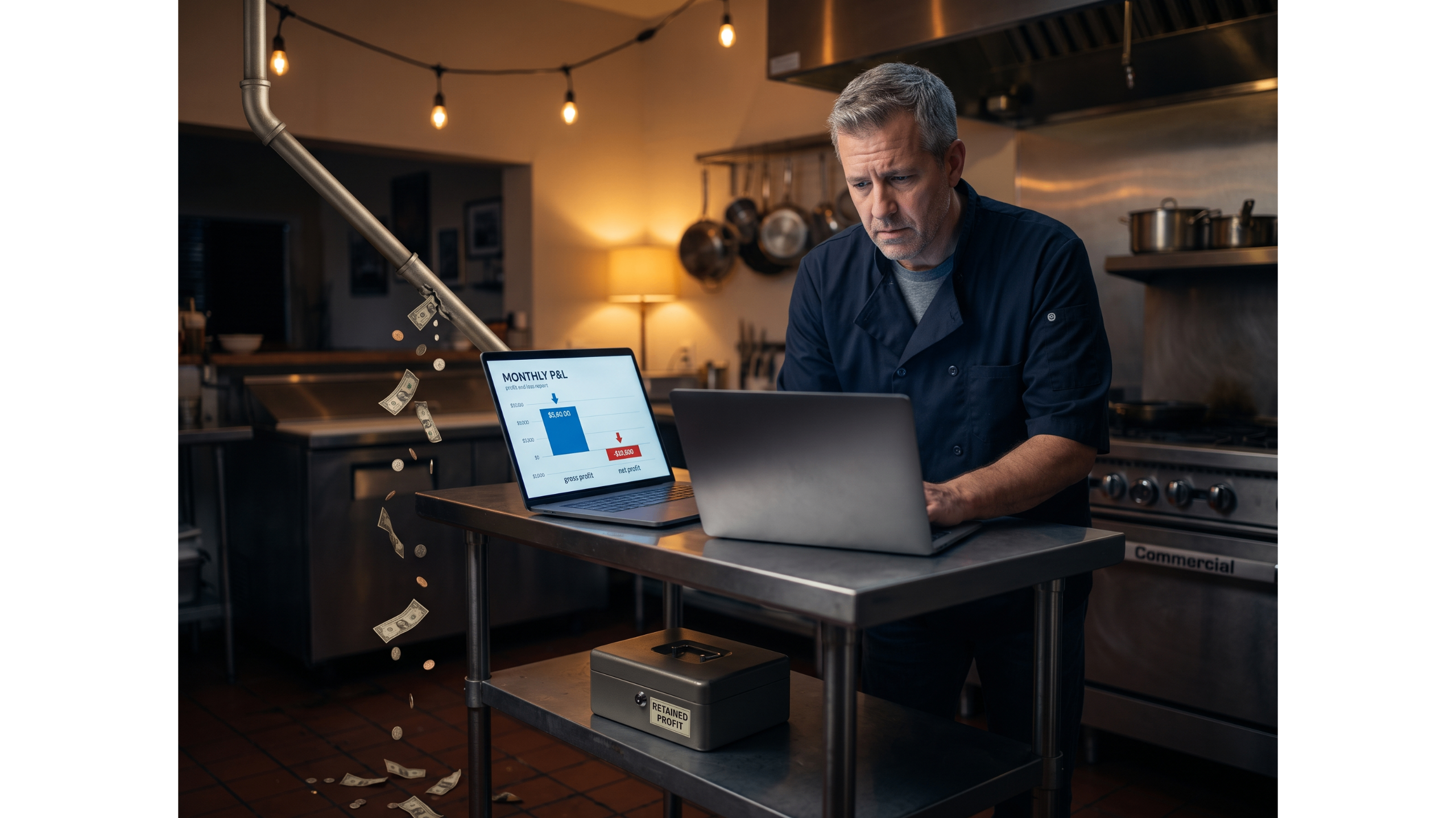
Every restaurant owner has lived this moment: the monthly report shows a profit, sometimes a healthy one, and yet the checking account tells a completely different story. Payroll is due, a vendor invoice just landed, and the cash simply isn’t there to cover it comfortably. Often nothing was miscounted at all — the P&L and the bank account are simply built to measure two different things.
This gap between what the paperwork says and what the bank statement shows is one of the most common sources of stress for independent restaurant operators. A closer look at why a restaurant P&L can say one thing while the bank account says another lays out exactly how this disconnect forms, and why chasing profit alone can leave an owner working hard without ever feeling the reward. Understanding the difference is the first step toward fixing it.
Profit on Paper vs. Cash in Hand
Profit and cash flow sound like they should be the same thing, but they measure entirely different events. Profit is an accounting calculation built from revenue and expenses recorded over a period of time. Cash flow is the actual movement of dollars in and out of the bank. A restaurant can report a profit while simultaneously running out of cash, and the reason almost always lives in the space between these two numbers.
Why the P&L Doesn’t Show the Bank Balance
The P&L statement is a mathematical summary of transactions, not a live snapshot of what’s sitting in the bank. It counts revenue when it’s earned and expenses when they’re incurred, regardless of when the actual cash changes hands. Several major outflows never show up as expenses on that statement at all, including debt principal payments, owner draws, equipment purchases, and inventory buildup. A restaurant can look profitable on paper while cash quietly drains out through payments the P&L never accounts for.
Money Sitting in the Account That Isn’t the Restaurant’s
Some of the money sitting in a restaurant’s bank account was never meant to be spent as profit. Sales tax collected from customers, tips owed to staff, gift card balances not yet redeemed, and upcoming loan payments all pass through that same account before they’re accounted for elsewhere. Treating that balance as available cash is one of the fastest ways to feel flush one week and short the next.
The Balance Sheet Blind Spot
While the P&L gets most of the attention, the balance sheet is where some of the most damaging blind spots quietly build up. Errors here don’t always show up right away — they tend to surface at the worst possible moments, like when applying for a loan or preparing for a review of the books.
Skipped Reconciliations and Hidden Errors
Skipping regular reconciliations is one of the most common and costly habits an operator can fall into. When bank statements, credit card processors, and accounting records aren’t matched up consistently, small errors can pile up without anyone noticing. Misclassifying routine expenses, like small repairs or disposable supplies, as long-term assets is another frequent misstep — that kind of misclassification inflates profit and creates a false sense of financial security.
Debt, Gift Cards, and Illusory Profit
Ignoring liabilities like outstanding debt and unredeemed gift cards can make a restaurant look more profitable than it actually is. A gift card sits on the books as a liability until it’s redeemed, meaning that cash isn’t truly earned revenue yet. Debt principal payments reduce the bank balance without ever touching the P&L as an expense. Left unchecked, these blind spots create the illusion of profitability while the business is actually losing ground.
Calculating Real Owner Take-Home
Once the gaps between profit and cash are understood, the next step is figuring out what an owner can realistically pay themselves without putting the business at risk. This is where net free cash flow becomes the more honest measurement to rely on.
The Net Free Cash Flow Formula
Net free cash flow is net profit minus everything that still has to be paid before an owner can safely take money home: loan payments, a tax reserve, a savings buffer for equipment failures and slow months, and a growth reserve for future marketing, equipment, or expansion. Restaurant coach Andrew Scott, host of the Restaurant Growth Accelerator podcast, has spent two decades running multi-unit restaurants and says most owners have never calculated this number once.
Fixing Finances in the Right Order
Trying to fix restaurant finances in the wrong sequence can add hours of extra work without adding a single dollar to the bottom line. The restaurants that consistently generate a real take-home number don’t start by chasing more customers — they tighten the cost structure first, then add sales volume on top of a business that’s already efficient. Working through the numbers in this order — lean cost structure first, then sales growth — keeps the business stable while still rewarding the person running it.
Death by Small Percentages
Some of the biggest cash leaks in a restaurant don’t come from one dramatic mistake. They come from small, seemingly harmless percentages that quietly compound month after month.
How 2-3% Over Prime Cost Drains $70,000 a Year
Being “only” 2 to 3 percent over target on food and labor costs sounds minor, but Andrew Scott’s own math shows that small overage can drain roughly $70,000 a year from a restaurant’s cash flow. Prime cost — the combined total of cost of goods sold and total labor cost — captures the two largest controllable expenses in any restaurant, which is exactly why small slips there hit so hard.
The 55% Prime Cost Target
Most independent restaurants run combined food and labor costs somewhere in the 65% to 75% range of revenue — Andrew Scott’s own benchmark for what’s normal. His target for a genuinely profitable restaurant is leaner: prime cost at roughly 55%, a meaningfully tighter number than the industry rule-of-thumb split of 30% cost of goods, 30% labor, 30% fixed costs, and 10% profit — a split that, after loan payments and taxes, rarely leaves much for the owner.
When Expansion Multiplies the Leak
Growth is often seen as the solution to a restaurant’s financial problems, but expansion has a way of multiplying whatever issues already exist rather than solving them.
Andrew Scott has described believing his biggest obstacle to opening more locations was access to capital — until he realized the real problem was that his existing business wasn’t profitable enough to fund expansion on its own. Two unprofitable locations don’t combine into one profitable one. Without a clear read on net free cash flow at every location, expansion can turn one manageable leak into several running at the same time, each draining a little more before anyone notices the pattern.
How a $6 Million Restaurant Loses Half a Million
Even a restaurant generating $6 million in annual sales can lose half a million dollars a year, a reminder that top-line revenue says almost nothing about financial health on its own. Bigger numbers on the sales report don’t automatically mean bigger numbers in the owner’s pocket.
Cash Flow, Not Profit, Keeps Doors Open
Profit is a useful measurement, but it’s a theoretical one. Cash flow is what actually pays the vendors, covers payroll, and determines whether the doors open tomorrow. A restaurant can look successful on paper for months while its bank account tells a much tighter story underneath.
Bring More Clients approaches this exact challenge by helping established restaurant owners look past the P&L and identify where revenue, margin, or cash flow may quietly be slipping away before more money gets poured into growth. That discovery-first mindset — understanding the business as it actually runs today, rather than guessing — tends to reveal opportunities a monthly report alone would never show.
One Practical Fix: Taking Sales Tax Off the Table
One line trips up more owners than any other: sales tax. It isn’t part of the profit calculation at all — it’s money collected on behalf of the state, not revenue the restaurant ever owned. The problem is that it sits in the same account as everything else and gets spent along with real revenue, leaving a bill the account can’t cover when filing day arrives.
Services like DAVO connect to a restaurant’s POS and set sales tax aside automatically every day, then file and remit it on schedule. (Disclosure: LocalRestaurantOwner.com, a Bring More Clients company, is a DAVO referral partner and may earn a commission through this link.)
Tracking prime cost, reconciling accounts regularly, and calculating true net free cash flow — rather than glancing at profit once a month — gives an owner the clearest possible view of what the business can really afford. Restaurant X-Ray Intelligence is built to make that tracking real-time rather than a month behind, turning “we had a good month” into a number an owner can actually plan around.
Bring More Clients
info@bringmoreclients.com
+17145535819
14071 Peyton Dr.
Unit 1232
Chino Hills
CA
91709
United States


